
If you’re a content creator and need to make videos for a living – at some point or another, you’ll run out of ideas. Videos all start to sound the same, and the scripts go nowhere. You might even find yourself copy-pasting bits of your old videos and just calling it a new one. That’s why having a system to come up with video ideas is so important – this, in my opinion, is where ChatGPT is helpful. It does have several limitations, and I would never recommend to take its content as a final draft.
I would use the capabilities of ChatGPT to streamline the scriptwriting process and create a more polished final product. In this article, we will explore the potential of using ChatGPT for scriptwriting and show you how to effectively use it in your own writing process.
First off: What is ChatGPT?
Everyone is talking about this thing. Not many people know what it is, outside of a “Bot that can answer and do anything.” There are a number of apps that use ChatGPT to answer things – from lawyers, to doctors, writing code, and even chat bots.
ChatGPT, according to OpenAI the developers of ChatGPT, stands for “Generative Pre-trained Transformer,” a large language model. It was trained on a massive amount of text data. It crawled the web for several years allowing it to understand and generate natural language. ChatGPT uses a deep learning technique known as transformer architecture, which enables it to understand the context of the input and generate more accurate and coherent responses.
Because it has the ability to understand inputs, and it has the ability to generate coherent responses, technically, it makes it a powerful tool for scriptwriting as it can generate dialogue and plot ideas that sound like they were written by a human. One way to use ChatGPT in ScreenWriting, is to use the platform to generate ideas and then develop unique lines of dialog which can later be edited. This can save a lot of time for writers as they no longer have to come up with every line of dialogue or plot point on their own.
Let’s figure out how to use ChatGPT for a simple script
The scriptwriting process is relatively straightforward. You have to give the system enough information on what you’re trying to talk about. Make sure that you spell it out the right way. A prompt can something like:
Write an outline for [What you’re looking for] that [Talks / Explains / Shows] [Your requirement]
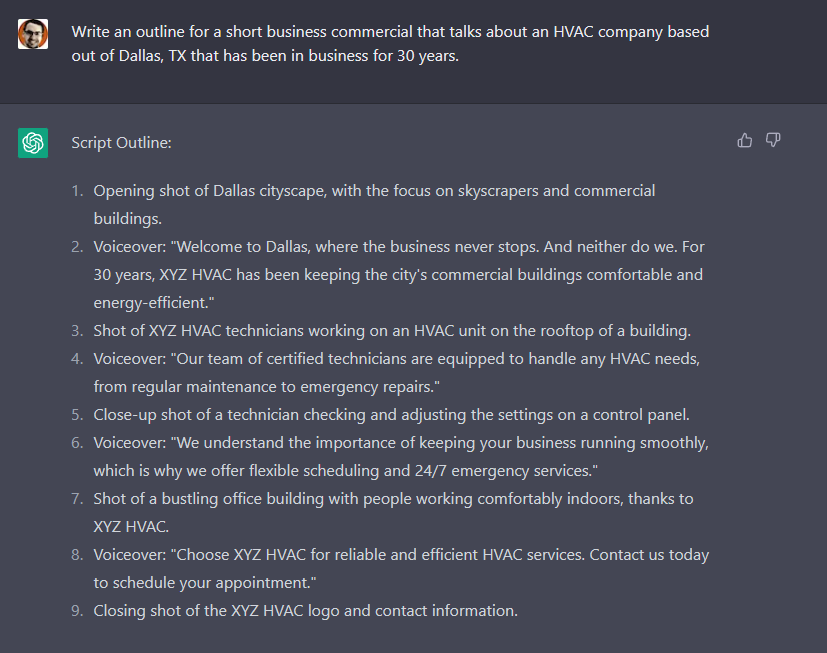
That script needs to be expanded on. A script outline like the one above makes a short 30 to 45 second long video. If you want to expand on that script, you need to take that same script, and use the platform to expand the script. Simply take the script that it spit out, and append it to the end of a statement that reads: “Expand the script to create a 3-minute commercial.”
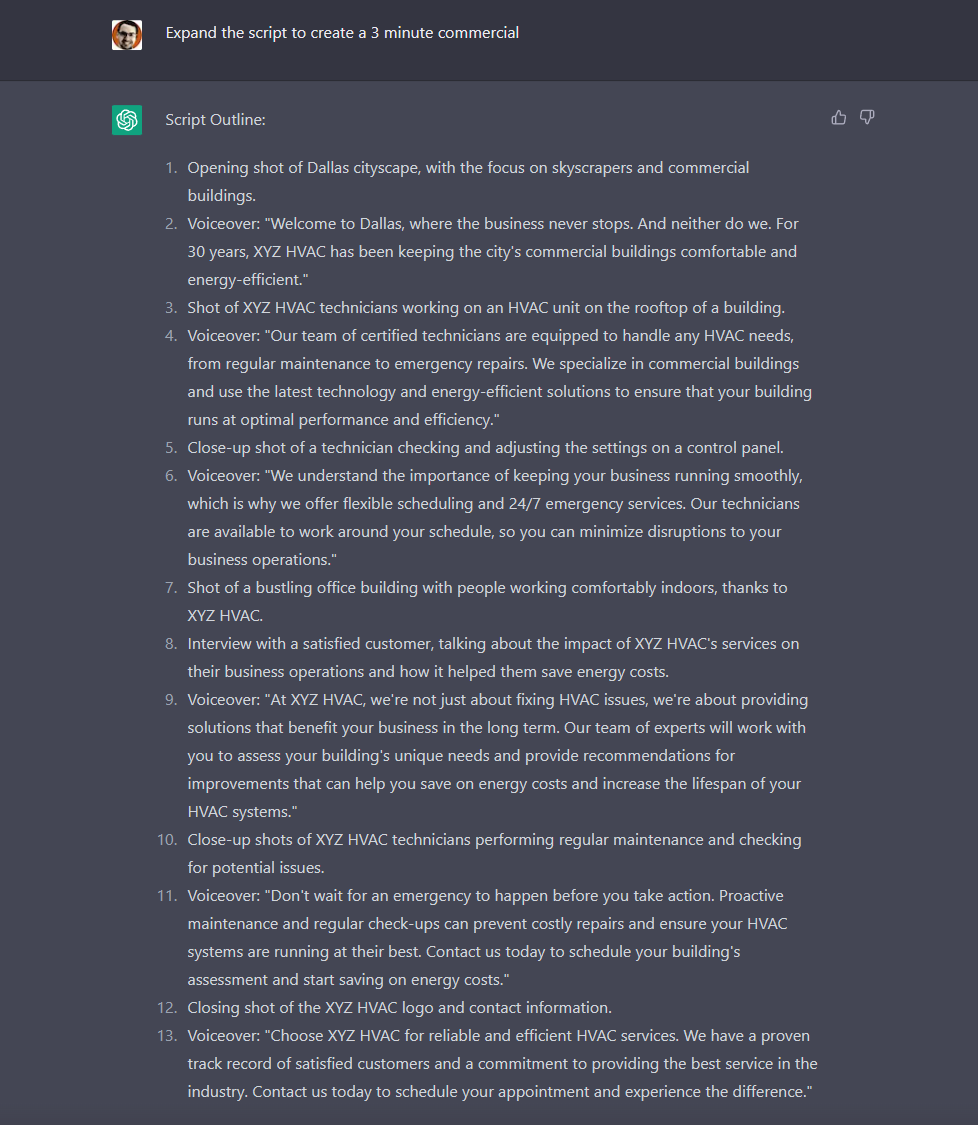
It’s important to keep in mind that while ChatGPT can generate coherent and natural language, it’s not perfect and may require some editing to make it fit the specific tone and style of the script. To get the most out of ChatGPT, it’s also helpful to be familiar with its capabilities and limitations.
What about Dialogs between two people?
In the unlikely event that you have to create a dialog between two people excitedly talking about HVAC services, it does a good enough job to iron out in the future:
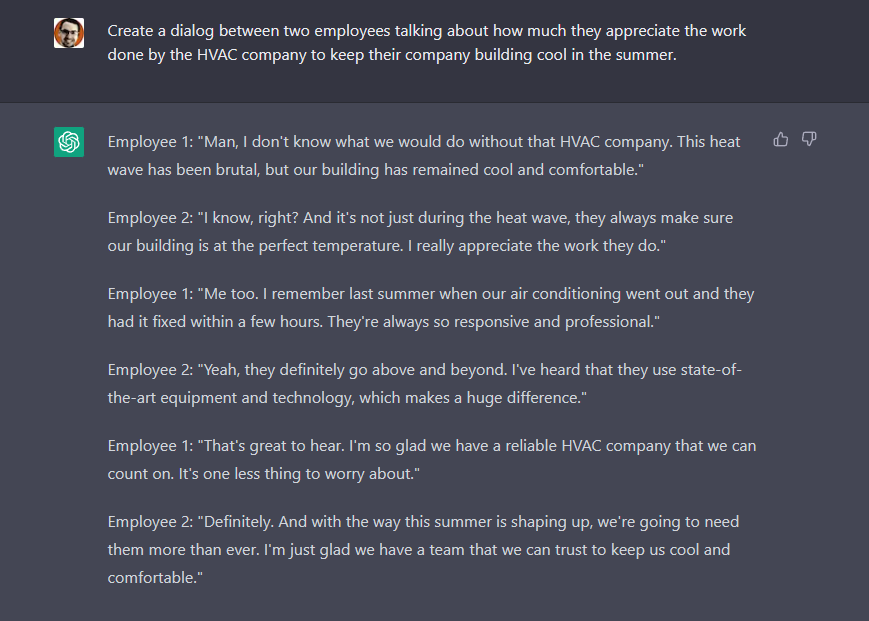
So, as a whole, ChatGPT does a good enough job to get the script rolling in the right direction. Will ChatGPT replace content writers and scriptwriters? I doubt it will – right now. You still need to know how to use it, what to ask, and how to piece things together. Not only that, but it does have limitation.
What about the limitations?
that script is pretty good by itself, but ChatGPT does have a ton of limitations. One of the main challenges is that it lacks an understanding of certain cultural references or idioms, which can result in dialogue or plot points that feel out of place or unnatural. Additionally, ChatGPT struggles to convey emotional depth and nuance, which is crucial in creating compelling and believable characters. Another limitation is that ChatGPT is not able to come up with ideas that haven’t been seen before, since it’s based on the data it’s been trained on, it can only output what it has seen before (2021).
To overcome these limitations and create a polished final product, it’s important to carefully review and edit the output generated by ChatGPT. This may involve adding cultural references or idioms, and tweaking dialogue or plot points to better convey emotions. Additionally, it’s important to use ChatGPT as a tool to help generate ideas, rather than relying on it to write the entire script. Learn how to use ChatGPT (or other writing software). Don’t be afraid of it, but don’t rely too much on its capabilities. It’s a tool – not an end all be all solution.


Recent Comments